Bulgarian Bombing Attempt on Bond
Casino RoyaleThe Bulgarian bombing attempt at Royale is a failed assassination plot whose apparent chaos conceals a second, deliberate betrayal: the bombers were themselves meant to die alongside James Bond. Its revelation turns a near-fatal street attack into evidence of a wider, carefully arranged operation, while leaving the person who commissioned it unidentified.
The attack and its immediate aftermath
The bombing interrupts a conversation when a nearby plate-glass window suddenly shatters and the blast rocks those seated inside. René Mathis orders Bond to stay where he is, then rushes out through the broken window-frame. The explosion thus arrives first as a violent interruption of ordinary surroundings, before its intended target or its full circumstances are clear.
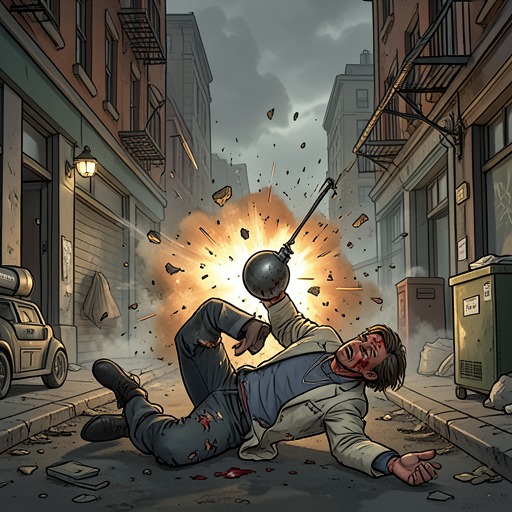
Bond later sees two men in straw hats carrying a bright red and a bright blue camera-case. As he approaches, the blue-case carrier appears to work at it, partly hidden from Bond by a plane-tree. A flash and explosion knock Bond to the pavement. When he regains enough awareness to look around, both men have been killed, the boulevard’s trees are damaged, and a crater smokes in the road. Bond begins to vomit. The attack has failed to kill him, but the blast’s immediate result is not a cleanly understood attempt on his life: it leaves a devastated scene and no surviving account from either of the two bombers.
Mathis identifies Bond as the target
After Bond tells Mathis what happened, Mathis concludes that the bomb was intended for Bond and that it must have been faulty. He supposes that the bombers meant to throw it and then shelter behind a tree, but that the attempt went wrong. At this point the explanation is plausible rather than confirmed; Mathis is explicit that the facts still need to be discovered.
Mathis also recognizes that the episode has changed the scope of their business. He had previously been involved in Bond’s private contest with Le Chiffre at the Casino; now he is personally caught up in a dramatic affair whose significance remains uncertain. He asks what the red and blue cases meant and wants fragments of the red one found. His response combines concern for Bond with an investigator’s attention to physical evidence and the escape plan that the bombers were supposed to follow.
The surviving bomber and the double-cross
The explanation comes through the account of the third Bulgarian, captured on the road to Paris. He was travelling in a Citroën and had picked up two English hikers as protective colouring. At a roadblock, his poor French prompted the patrol to ask for his papers; he drew a gun and shot one of the motorcycle patrolmen. The other patrolman captured him and stopped him from killing himself. Taken to Rouen, he gave an account of the operation.
The Bulgarians belonged to a pool in France used for jobs involving saboteurs and thugs. They had been promised two million francs to kill Bond and were told by the agent who briefed them that following instructions would make capture impossible. That promise framed the job as a dependable plan, but its apparent security depended on a lie about the equipment they had been given.
The agent supplied the two camera-cases and assigned them different functions: the blue one was said to contain a powerful smoke-bomb, while the red one held the explosive. The bombers were instructed to trigger the blue case as the red bomb was thrown, then escape under cover of smoke. In fact, the cases contained identical high-explosive bombs. There was no smoke-bomb and no meaningful difference between the red and blue cases. The plan was not simply to attack Bond; it was to arrange for the attackers to be destroyed with him.
The Bulgarians did not trust the briefing completely. They decided to set off the supposed smoke-bomb first, intending to throw the explosive from within the resulting cloud. The device they activated was not a screen for escape but another bomb. Their attempt to outwit the plan therefore brought about the outcome the agent had concealed: the explosion killed both men as well as leaving Bond alive. The difference between the cases, carefully emphasized through their vivid colors, proves to be a manufactured distinction rather than a useful difference in their contents.
Capture, evidence, and unresolved responsibility
The third Bulgarian had waited behind the Splendide to collect his companions. Seeing the explosion, he assumed they had bungled the attack. Police later recovered fragments of the unexploded red bomb and confronted him with them. Those fragments helped him understand that the men had been deceived and were meant to be killed too; after that discovery, he began talking. The physical evidence thus does more than identify a failed device: it exposes the betrayal on which the operation was built.
The surviving man’s account does not resolve who ordered the attack. There is nothing in it to connect the operation directly to Le Chiffre, and the captive says that name means nothing to him. The job may have come through an intermediary, possibly one of Le Chiffre’s guards, but this remains a possibility, not an established fact. Mathis’s earlier suspicion that Bond was the intended target is supported by the account; attribution to Le Chiffre is not.
The attack’s outcome is consequently divided. Bond survives, the two men who carried the cases are dead, and the third participant is in custody and providing information. Yet the identity of the agent who supplied the bombs, the existence of any further plans for the third man, and the connection, if any, to Le Chiffre remain unsettled. The red and blue cases make that uncertainty tangible: they appear to offer a readable scheme, but their supposedly distinct roles conceal a single destructive purpose.